Category: Biblical Teaching

  • Sunday Services 2001

    Welcome to Sunday Services 2001

    This site is provided by the Archbishop of Sydney’s Liturgical Panel to make the material in the book Sunday Services available in electronic form for use in Overheads, PowerPoint or service sheets. We also hope that those outside the diocese will benefit from our making this material available in this form.

    Sunday Services Online provides important explanatory material that will assist you in understanding and using the services. By investing a few minutes in reading these pages you will gain more out of them.

    Important Copyright Information

    The text is copyright, however permission is given for reproduction of this material provided no commercial advantage is obtained. Notice of copyright must appear on the title page or at the end of the services as follows:

    This material is © copyright 2001 by The Archbishop of Sydney’s Liturgical Panel. Used by Permission.

    There is no charge for us of the material.

    All use must comply with the requirements of The Constitution of the Anglican Church of Australia. Enquiries concerning these requirements may be directed to a regional Archdeacon.

    It is important that people manipulating the text files do not change the text nor alter the structure in any significant way. Such actions will mean that a service, for which permission to use has been obtained, is no longer authorised and also breaches the terms and conditions governing use of this material.

    Introduction 

    This collection of resources aims to provide a liturgy which is biblical in content, intelligible in language and appropriate to our time and culture.

    Christians meet with the risen Christ. Jesus died in our place, was raised from death and ascended to heaven where he is worshipped by the redeemed people of God and the whole creation. Here on earth, Christians join in the praises of the heavenly assembly.

    God’s people have always assembled with him. In the Old Testament period, their identity was shaped by the experience at Mount Sinai. The law called them to meet with God through the mediation of priests and Levites. The ritual of temple and priesthood was superseded by the work of Jesus on the cross. In the New Testament period, meeting together with God was no less important (Hebrews 10.25). Through Christ, in one Spirit, we draw near to the Father, to worship him, to learn from him, to be edified and to encourage one another to love and good deeds, as we serve God in the world.

    No pattern for the meeting of Christians is set down by the New Testament. In the book of Acts and the Epistles, however, there are indications of what they did when they met. They sang, heard the Scriptures read and explained, remembered and proclaimed the death of Jesus, and offered prayers not only for themselves but for all people.

    In time, Christians developed forms and patterns for meeting together, which we call liturgy. The regular use of an agreed liturgy plays an educative and pastoral role, for it can uphold doctrinal orthodoxy and build a framework for devotion to God. It also helps maintain fellowship between congregations.

    As Anglicans, we stand in the Reformation tradition of Archbishop Cranmer who compiled what became The Book of Common Prayer (1662). Cranmer’s aim was to give Scripture and its teaching central place in liturgy. He sought also to be clear, simple and intelligible so that the people of his day could readily understand what was said and done in church.

    For Australian Anglicans, The Book of Common Prayer was the only authorised liturgy until 1978. With the publication in that year of An Australian Prayer Book, there were more resources, a modernising of Cranmer’s services and an attempt to do in a fresh way for Australians what Cranmer had done in the sixteenth century for England. Since 1978, other liturgies have been produced in Australia and around the world, often because the earlier revisions dated quickly. An Australian Prayer Book is well used and liked in many places; for others it is too bookish and stilted.

    This current edition of Sunday Services is an attempt to present services which will glorify the God we serve and build up and encourage his people when we gather in his name.

    Margaret Collison, Glenn Davies, Trevor Edwards (Secretary), Robert Forsyth, Raymond Heslehurst, Lesley Hicks, Boak Jobbins (Chair), David Lakos, John Mason, Paul Perini, Lindsay Stoddart, Lawrence Bartlett (Consultant).

    understanding and using this book
    Sunday Services is a collection of services designed to suit a variety of occasions in most parish churches on Sundays. It contains two types of regular service: those modelled on the Morning and Evening Prayer pattern and those for the Lord’s Supper. There is also a service of initiation.

    The Sunday Services web site includes an extra service, A Service for Today’s Church, that has not been included in the book itself. This service can be adapted either for a ‘word and prayer service’ or for a Lord’s Supper. The recent origin of the service is A Modern Liturgy in Prayer Book Revision for Australia (1966), but it reflects the intended use of BCP, with its weekly combination of Morning Prayer, the Litany and the Ante-Communion, with only occasional celebrations of the Lord’s Supper.

    Within that general description, there is great variety. Each service allows alternatives and room for flexibility. Before using any of the services, familiarise yourself with them all, together with the introductory notes. You will then be able to choose the most appropriate form.

    Having chosen the service to use, you will then need to add the components – Bible readings, hymns and songs, prayers, other music and so on. Music has the power to move our wills and emotions. If used well, it can also be an effective medium for teaching. Its purpose is to support a service rather than control it, so take care with the choice of music, where in the service it is placed and the tunes used.

    Another issue is what to put in the hands of the congregation. Some churchgoers are comfortable being given a book. For others, this is off-putting. For each occasion, you might print an order of service, with the hymns and Bible readings so that people have all they need on one sheet of paper. Alternatively, print the outline of the service on a reusable card. While the text is supplied in its entirety on this site, text should be kept to a minimum, using the major headings so that people understand the flow of the service, together with those parts said by the congregation. They do not need the text of the leader’s parts, nor the notes about the placement of Bible readings and sermons: simple headings are enough. Another option is to distribute nothing, using an overhead or data projector for the people’s parts.

    The clear structure of the services in Sunday Services will both free people to participate and teach them what is significant about their meeting together. If you are reprinting any of the material, please ensure the major headings are included so the congregation knows what it is doing and where it is going. Similarly, when you reprint the congregation’s parts, please observe the line breaks: they are there to aid understanding and participation together.

    reading the bible in church
    Anglican liturgical practice has always given the Bible central place in all its services. From the beginning, it was intended that each service contain a psalm as well as readings from the Old and New Testaments: the purpose was to help people become familiar with the full account of God’s work in his world. Each year various lectionaries are produced to facilitate that.

    The structure of the services in Sunday Services assumes that the Bible will continue to take a central place in our liturgies. If a standard lectionary is used, the sermon might explain one or all of the readings. If a teaching program separate from the lectionary is being followed, then one of the readings may be replaced by one on which the sermon is based: in this case, an attempt should be made to maintain the continuity of the unchanged readings. Alternatively, where a teaching program is followed, another reading may be added just prior to the sermon.

    the use of the historic creeds
    Although the New Testament contains what might be called apostolic affirmations, for example, 1 Corinthians 15:1-11, Philippians 2:5-11, Colossians 1:15-20, 1 Timothy 3:16, the early church developed creeds to state and defend those beliefs held in common by all Christians. The Apostles’ and Nicene creeds stand as agreed confessions of our common faith in the person and work of the triune God, in which we praise and honour God together with all Christians in all times and places. It is therefore appropriate that one of these historic creeds should be a standard feature of our gatherings. There may be occasions when an apostolic affirmation from the Bible or a song declaring the Christian faith is suitable. However, to remain true to the Christian faith, which is trinitarian, and to our Anglican heritage, those who lead services should ensure that the norm is to use one of the historic creeds.

    the lord’s prayer
    In response to a disciple’s request, ‘Lord, teach us to pray’ (Luke 11:1), Jesus taught the Lord’s Prayer. Whether it was intended as a pattern for prayer or to be said on each occasion Christians pray, the Anglican custom is that it is said at some point in each service. It is helpful as a model for prayer and ought to continue as a regular feature.

    the collects or prayers for the day
    Originally, the purpose of the Collect was to collect into a prayer the thrust of the readings and the theme of the particular day in the Church’s year. It is recommended that the practice of a prayer for the day be continued. BCP and AAPB are a rich source for such prayers. If a prayer is to be composed, the writer should bear in mind the purpose of prayers for the day.

    posture
    The Book of Common Prayer gave detailed instructions about standing, kneeling and sitting at different points in services. These days local custom generally prevails. Where they occur in Sunday Services, the directions to stand, sit or kneel are suggestions only.


    Services of  Prayer, Praise and Proclamation 

    The three Prayer, Praise and Proclamation services provide a variety of forms for the gathering of God’s people. Each takes its shape around the regular reading of the Bible. PPP 1 commences with confession; PPP 2 begins with praise and thanksgiving, with the confession coming as a response to the preaching; PPP 3 allows for the sermon to be the climax of the service.

    Perhaps more than the other services in Sunday Services, these will work best if the leader has plenty of time to plan and prepare. They can be fresh and different each time and hang together as a whole if music, prayers, confessions are all carefully chosen.

    As we have noted, each service has a particular shape: the different shapes suit different occasions. Think about a particular occasion – what is its purpose? who will be present? what is the theme? – before deciding which form to use. Once the purpose of a service is clear and what it is meant to achieve, choosing options and alternatives is much easier.

    At several points, you can use the alternatives listed below, under Occasional Prayers and Other Resources and also BCP or AAPB. Be careful to ensure an alternative set of words serves the same purpose as those they replace. The Declaration of Forgiveness should be replaced with a declaration of forgiveness, not with another prayer for forgiveness.

    Download services of Prayer, Praise and Proclamation (55KB)


    Occasional Prayers And Other Resources
    These occasional prayers are provided for use at appropriate points in the Sunday services to enrich and facilitate the prayer participation of the congregation in our worship together. The language is varied and aims to be simple and contemporary, with the lines short, rhythmical and easy to read aloud.

    The selection is designed to be flexible, including both set prayers and patterns for prayer. There is a range of set prayers of varying length, complexity and content within each category, while the patterns provide suggestions and guidelines and allow a choice of wording by the leader with set congregational responses.

    The selection in this book is not intended to cover all possible needs and occasions. Other more comprehensive modern resources are available.

    For many regular Sunday worshippers, personal prayer during the week may be unstructured and narrowly focussed. These occasional prayers, while primarily designed for Sunday services, may also be used to enrich and widen the focus of the daily prayer life of the church member.

    Download Thanksgivings (9kb)
    Download Confessions (11kb)
    Download Intercessions (34kb)
    Download Dismissals (8kb)
    Download Affirmations of Faith (15kb)


    Services of the Lord’s Supper 

    form 1: why this form?
    This order of the Lord’s Supper is meant to be no more than an up to date translation of the Holy Communion Service in the Book of Common Prayer (BCP) of 1662. It intends to follow closely the shape and theology of Book of Common Prayer (BCP) while using accessible contemporary language.

    While other services of the Lord’s Supper may include emphases on the resurrection of Christ and his coming again, this particular Holy Communion, deriving from Thomas Cranmer’s remarkable service of 1552, is unambiguously focussed on the death of the Lord Jesus Christ.

    The service is therefore a modern presentation of the classic Anglican Lord’s Supper, and was written to keep this style of service, with its special focus on the atonement and justification by faith.

    form 2: why this form?
    The Second Order is a development of the Lord’s Supper services in Experimental Sunday Services 93 and is intended to meet the need for a simple but meaningful Lord’s Supper service in a modern form.

    The Second Order of the Lord’s Supper is two versions of the one service [A and B]. Second Order A has the confession of sin early in the service and a modern version of the prayer of humble access in the Preparation for Communion. The Second Order B has the confession later in the service as part of the Preparation for Communion and there is provision for the greeting of peace following it. Otherwise both versions are identical.

    Using these Forms
    The services are in two basic parts. Gathering in God’s Name, Hearing God’s Word and The Prayers form the first part and may be conducted from where services of the word and prayer are normally conducted. The second part of the service, which begins with Preparation for Communion, focuses particularly on the Holy Communion and should be conducted entirely from the Holy Table with the possible exception of the last section, Going out to Serve (in Form 2).

    Download Service of the Lord’s Supper 1 (41kb)
    Download Service of the Lord’s Supper 2 (A & B) (65kb)


    Order of Baptism

    This Order for Infant Baptism is offered as a simplified version of “An Order for Baptism 1973”, which was produced in Sydney and formed the basis of An Australian Prayer Book First Order. The only difference in structure is the use of Second Order style questions to the candidate.

    This service may be inserted into services of Prayer, Praise and Proclamation or the Lord’s Supper and replaces the creed.

    Whenever possible, baptism should be administered at a public service, not only so that the whole congregation may welcome the newly-baptised into Christ’s church, but also so that Christians may be reminded of the profession of faith and obedience to God which they made in their own baptism.

    It is desirable that the child’s parents join the godparents in answering the questions in this service. Parents may be godparents for their own child.

    The congregation may be invited to join in saying the words at # 7 We praise the God and Father

    If this service is used apart from a public service on Sundays, readings may be taken from the following or other suitable passages: Genesis 9:8-17; Psalm 127; Matthew 28:16-20; Mark 1:1-11; Mark 10:13-16; John 3:1-8; Acts 2:37-42; Romans 6:1-11; Galatians 3:23-29.

    Download Service of Infant Baptism (14kb)


    A Service for Today’s Church

    A Service for Today’s Church has its origins in “A Modern Liturgy”, an experimental form of service prepared by the General Synod Prayer Book Commission and published in Prayer Book Revision in Australia in 1966. A Modern Liturgy was intended as the principal service of Sunday, whether morning or evening, when the congregation as a whole came together and the Lord’s Supper was administered: it was also to be used when there was no communion. As such, A Modern Liturgy was designed in one order of service to do what in 1662 was done in the three services of Morning Prayer, the Litany and Holy Communion, or ante-communion where there was no communion.

    It was John Mason who conceived of a return to A Modern Liturgy as a way ahead in liturgical revision. Over several years, in consultation with others, he prepared several versions of A Service for Today’s Church. It has been used extensively and adjusted in light of comments and reactions.

    The particular features of A Service for Today’s Church are that it is adaptable, flexible and can provide cohesion within a parish. It is able to be used as a Morning or Evening service and as a service of Holy Communion without the Communion section being an appendage. Likewise, it has been used in a formal, traditional Anglican context where people value having every word printed out to follow and join in, as well as in congregations where a formal liturgical service is perceived as unfriendly and unedifying. Moreover, in church life today there is rarely one meeting time where the church of a given place can be said to gather. The norm is that different congregations meet at different times and adopt different service patterns, ranging from the formal to the informal. As a liturgical resource, ASTC can be used to meet the needs of both formal and informal styles of gathering. The single resource, with its recognisable framework and common prayers, can enhance the cohesion and sense of unity between the congregations that constitute a local church.

    Download A Service for Today’s Church – Morning / Evening Church
    Download A Service for Today’s Church – The Lord’s Supper Or Holy Communion


    Acknowledgements

    Except where stated, texts are the original work of the Archbishop of Sydney’s Liturgical Panel. Every effort has been made to identify owners of copyright material. Omissions will be rectified in future editions of this work.

    Some section are based on An Australian Prayer Book (1978) and its sources and A Prayer Book for Australia (1995), © The Anglican Church of Australia Trust Corporation. Used by permission.

    Scripture quotations taken from the Holy Bible, New Revised Standard Version copyright © 1989, Division of Christian Education of the National Council of the Churches of Christ in the United States of America.

    The English translations of The Lord’s Prayer, The Apostles’ Creed and the Nicene Creed are those prepared by the English Language Liturgical Consultation (ELLC) with minor modification. Explanations for these modifications may be found in A Prayer Book for Australia (1995) pages 820-821.

    The prayer at paragraph 17 of Lord’s Supper (2A) is by David L. Frost © The Central Board of Finance of the Church of England, used by permission.
  • What ? Resources for Service Building

    If you only read one thing…

    Click here for a simple, one-page guide for those planning services from scratch.

    ServiceBuilder

    Click here to use ServiceBuilder to build your services online. You can incorporate established forms of service or create your own templates.

    The Building Blocks

    Click here to find a range of prayers, praises, greetings, confessions of faith, assurances of forgiveness, scripture texts, creeds, and other liturgical resources, old and new. These can be individually copied for your own use or accessed through Service Builder.


    Sunday Services 2001


  • QuickStart for Formal Services

    QuickStart for Formal Services

    QuickStart for Formal Services

    ServiceBuilder contains the full text of regular services from BCP, AAPB and Sunday Services.  It also contains liturgical resources from a variety of other sources, allowing you to integrate different confessions, creeds and prayers (for example) into existing forms of service.


    Resources for Occasional Services


    Baptisms Weddings Funerals Confirmations
    baptism wedding Cemetry Roses Confirmation

    Prayer Templates (Service Builder)

    Click here for a prayer template

  • Welcome to the Better Gatherings website!

    Welcome to the Better Gatherings website!


    Our Theology of Church Our theology in practice Resources and tools for service building


    This site is designed to equip service leaders to craft meetings that by their shape, their contents and their tone proclaim the gospel of Christ, build his body in the unity of the spirit and bring honour and glory to God. On this website we would like to help you reflect biblically and historically on just how good church can be, and give you the resources you need to put this vision into practice.

    You may be keen to go straight to the practical guidelines or resources sections, but take time to work through the biblical and historical sections, so that you are clear about God’s will for our gatherings and understand how Christians have sought to put biblical teaching into practice across the centuries.

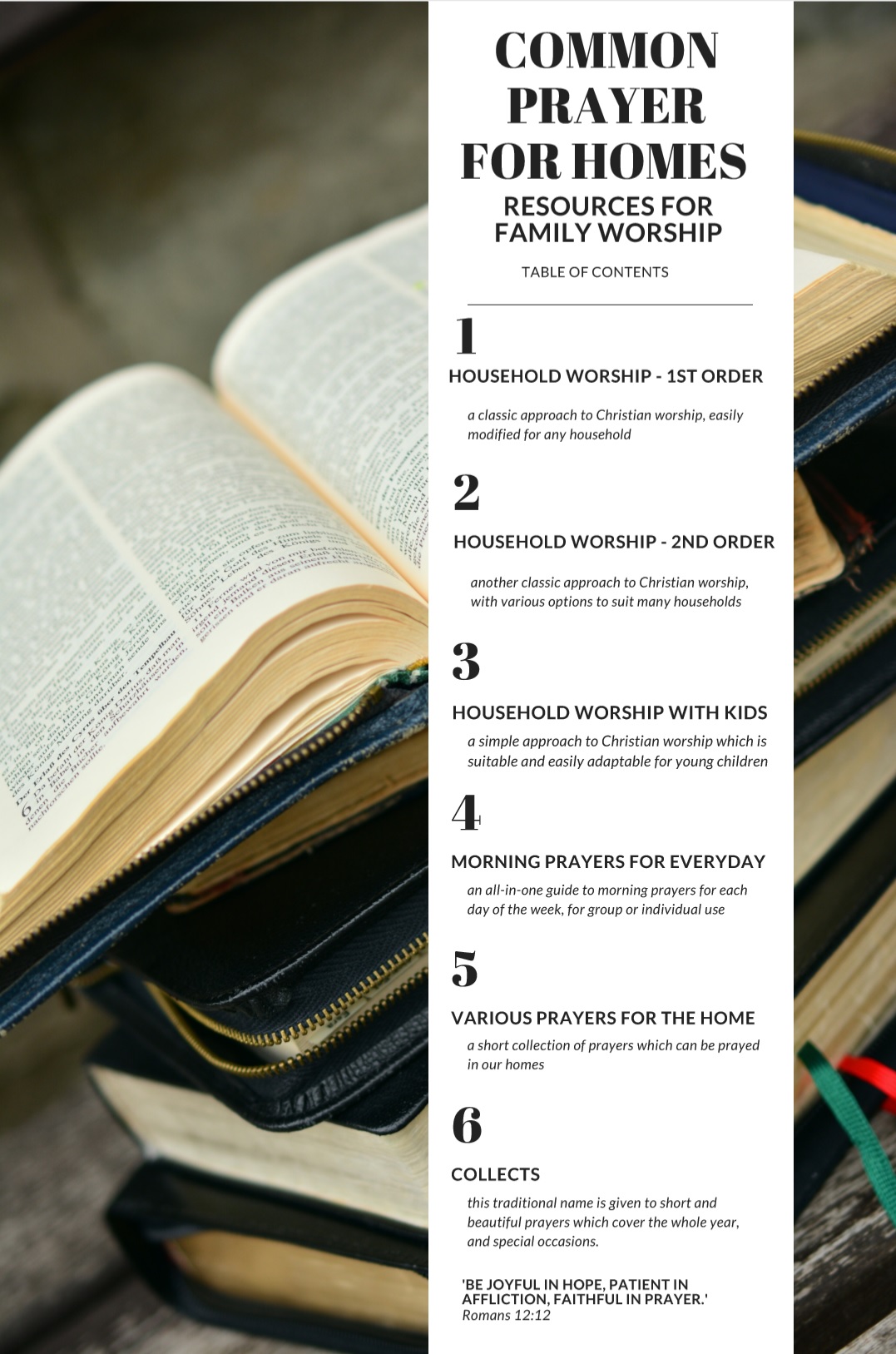
    Download Common Prayer for Homes: Resources for Family Worship

    A new liturgical resource has been completed which provides flexible forms of household worship to serve the churches, by complementing the spiritual resources already being offered during this difficult period: Common Prayer for Homes: Resources for Family Worship.  We trust it will be of some assistance to the ministry already taking place in homes, and ultimately we hope that it provides some good benefit to the spiritual lives of Christ’s flock.

    The most recent edition can be downloaded with the below link:

    Click Here to Download Common Prayer for Homes: Resources for Family Worship

    There has been a new format produced, which can be printed using double-sided A3 paper to make a booklet which can be stapled together.  This new version can be downloaded with the below link:

    Click Here to Download Common Prayer for Homes: Resources for Family Worship – Printable.

    Click Here to Download Common Prayer for Homes: Resources for Family Worship – Printable (every second page rotated if printed in automatic duplex mode).

    The prayers in this liturgical resource can be copied and pasted using the below download:

    Click Here to Download the Main Component of Prayers in .docx format.

    Common Prayer in Homes

  • Gathered for worship

    The New Testament adapts the terminology of worship found in the Old Testament in two significant ways. First, it describes Jesus in his death, resurrection, and ascension as the great high priest who has offered a perfect sacrifice to fulfil and replace the worship associated with the tabernacle and temple. The Lord Jesus enables us to approach God with confidence, as those who have been purified, sanctified and perfected by his finished work, and to live in God’s presence forever (Hebrews 5:7-10; 8:1-6; 9:11-14; 12:22-24).

    Secondly, the New Testament uses worship terms to describe the response we are to make to Jesus and the gospel. Some terms are applied to the service that we offer to God in everyday life, as we gratefully respond to the grace he has shown us (Romans 12:1; Hebrews12:29; 13:16). Similar terms are used to describe particular ministries that God gives to advance the gospel and build his church (Romans1:9; 15:15-16; Philippians 2:17; 4:18). The exercise of gifts in any context may be regarded as an expression of worship if the ministries are genuinely for the benefit of others and for the glory of God.


    Reflection: Read Acts 13:1-3 and consider:

    • What is meant by ‘worshipping the Lord’ (literally ‘serving the Lord’) in this context?
    • What other activities might we legitimately include under the heading of congregational worship?
    • What is the relationship between serving the Lord and serving one another in a congregational context?


    Another set of worship terms expresses the submission to Christ and homage that is involved in confessing his true character and becoming his disciple (Matthew 14:33; John 9:38; 1 Corinthians 14:24-5). Praise is particularly associated with submission and homage in the Psalms (95:1-6; 96:1-9; 99:1-5) and in the Revelation to John (5:9-14; 7:9-17; 15:3-4). Praise is our calling as Christians and an expression of our true identity (Ephesians 1:3-14; Hebrews 13:15; 1 Peter 2:9-10).

    As we gather to express who we are as the redeemed people of God, we worship God by hearing his word with faith and by responding with submission and praise. As we celebrate the victory of Christ and enjoy its benefits together, we echo the songs of the heavenly assembly and anticipate the worship of the new creation (Revelation 5, 7).

    Such references suggest that it is consistent with Scripture to talk about a church ‘service’, and to view congregational ministry as a means of worshipping God. However, since other terms such as fellowship and edification can describe the purpose of gathering, it is not helpful to use ‘worship’ as the main or exclusive term. Moreover, it is important not to obscure the fact that worship belongs to the whole of life. While all ministry must be understood as a response to God’s grace, and not in any sense a cultivation of his favour, ministry to others when the church gathers is an important aspect of our service or self-giving to God.

    The ‘vertical’ and the ‘horizontal’ dimensions of what takes place should not be artificially separated. One part of our meetings cannot be ‘the worship time’ (prayer and praise) and another part ‘the edification time’ (preaching and exhortation), since New Testament teaching encourages us to view the same activities from both points of view.

    Next: Gathered for fellowship in Christ

  • Building towards maturity in Christ

    Christians are members of the heavenly or ultimate assembly that Christ is gathering to himself (Matthew 16:18; Hebrews 12:22-4). From an earthly perspective, however, the church is still growing and being built (Ephesians 2:19-22; 1 Peter 2:4-5). This process of ‘edification’ involves growth in size and maturity, as we progress in our relationship with the Lord Jesus and with one another. In fact, Christian assemblies require further ‘building’ to prepare them to meet Christ on the last day (Colossians 1:28).

    Reflection: Read Ephesian 4:11-16 and consider how edification takes place.


    • What is the role of the Lord Jesus? 
    • What is the role of leaders? 
    • How do members of the body contribute to the process?


    Playing our part

    Many gifts and ministries are given by God to believers, to enable this growth and development to take place (Romans 12:3-8; 1 Corinthians 12:1-31). Most importantly, these gifts and ministries are to be exercised in love. Believers meet together to be established and strengthened in faith, hope and love, encouraging one another to serve God in every sphere of life, as they await the day of Christ’s return (Acts 2:42; Hebrews 10:24-5; 12:28-9). Everything that takes place in the assembly – praying, singing, exhorting, teaching, confessing, giving – must be for the edification of the church (1 Corinthians 14:1-19).

    Intelligibility is an important issue here. People need to grasp the meaning of what is being said or sung, so that they can say ‘Amen’ and be wholeheartedly involved in the process of strengthening the church. What does this teach us about the content and style of our singing, praying and teaching? What might be a hindrance to edification?

    Edification involves the growth of individuals, as well as the development of relationships and ministries, ‘until we all attain to the unity of the faith, and of the knowledge of the Son of God, to mature manhood, to the measure of the stature of the fullness of Christ’ (Ephesians 4:13). As already noted, when we are ministering God’s truth to one another in love, edification may also have an evangelistic outcome (1 Corinthians 14:24-5).

    Order and discernment are also important factors in the edification of the church. Although many may wish to contribute, they should do this in a controlled manner, allowing opportunity for careful evaluation by others, and reflecting the fact that ‘God is not a God of confusion but of peace’ (1 Corinthians 14:26-40). Everything should be done ‘decently and in order’, so that all may be instructed and encouraged.

    Learning from leaders

    Christian assemblies are called into being and grow through the ministry of God’s word and God’s Spirit. As already noted, this means that the gospel and the Scriptures must be at the centre of everything we do together. Believers generally have a part to play in building the church through Spirit-directed ministries of the word, and through praying, praising or giving thanks to God.

    At the same time, there is a vital role for teachers, overseers and elders, who are to ‘hold firm to the trustworthy word as taught’, so that they might be able to ‘give instruction in sound doctrine and also to rebuke those who contradict it’ (Titus 1:9). In the post-apostolic age, those who shepherd the flock of God are guardians of the gospel (2 Timothy 1:13-14), solemnly charged with preaching, warning, and encouraging believers (2 Timothy 4:1-2; Titus 2:15; Hebrews 13:17). Such leadership is vital to the Christian assembly for its ongoing growth towards maturity and fidelity to the gospel.

    Conclusion and summary: List the six most important things you have learned from reflecting on biblical teaching about the gathering of God’s people.  Then consider:


    • What needs to change in the way you think and talk about ‘church’?
    • What needs to change in the way you prepare and lead services?


  • Gathered for fellowship in Christ

    We meet together because by God’s grace we belong together. We have all heard the one gospel, received the same Spirit, and been united as members in the one body of the Son. We meet to express the fellowship in Christ that is God’s gift to us. Unbelievers may be present and should be welcomed, but the primary purpose of the regular gathering is not to evangelise unbelievers.

    Reflection: Read 1 Corinthians 14: 23-5 and consider how unbelievers might be converted in the course of an ordinary church meeting.


    • What should we do to make sure that they are not hindered in understanding the gospel?
    • In what positive ways should our gatherings take account of the presence of unbelievers?


    The nature of Christian fellowship

    Christian fellowship is a sharing together in Christ and the benefits of his salvation, not merely friendship with like-minded people. We participate in something beyond ourselves. We are always in fellowship with each other and the Father through the Spirit (Ephesians 2:18), because we are all members of the heavenly assembly of Christ. We have believed the apostolic witnesses and share in the apostles’ fellowship with the Father and the Son (John 17:20-3; 1 John 1:2-3).

    Nevertheless, there is a practical demonstration and experience of that fellowship when Christians assemble here on earth (Acts 2:42-47). Encountering God together shapes the nature of our relationship with God and determines the nature of our relationships as the community of Christ. We are addressed by God as a congregation of his people, and respond together in prayer, praise, and submission to his will. We grow together in him and share together in the grace he bestows (Ephesians 4:11-16).

    The presence of God

    Matthew 18:20 and 1 Corinthians 5:3-5 indicate that the Lord Jesus Christ is truly present when his people gather in his name. While these passages focus on meeting to make disciplinary decisions, the promise of Christ’s presence applies to any assembly in the name of the Lord. He speaks through the gospel and the Scriptures (Colossians 3:16; 2 Timothy 3:16-17; Hebrews 3:7-11), and through Spirit-directed ministries of exhortation, admonition, and encouragement to one another (1 Thessalonians 5:14-23; Hebrews  3:12-15; 10:24-5). Christian assemblies may therefore be referred to as ‘God’s temple’, because God’s Spirit is living and working in and among his people (1 Corinthians 3:6-7; 2 Corinthians 6:16).

    The Lord’s Supper

    The Lord’s Supper is a particular way of expressing our fellowship in the Lord, since it is ‘a participation together’ or means of sharing together in the benefits of Christ’s sacrifice (1 Corinthians 10:16). Paul makes it clear that this is only possible because Christ as the ‘one bread’ has brought us together as ‘one body’ (10:17). ‘Christ our Passover lamb has been sacrifice for us’ ( 5:7), and his death has formed the new people of God. For this reason, believers must behave considerately towards one another, ‘discerning the body’ (11:29) in their gathering. Only through displaying love for one another in sharing this meal together do we truly ‘proclaim the Lord’s death until he comes’ (11:26). The power of the cross is seen in the reality of Christian fellowship.

    Confessing together

    Confession in the New Testament means the open and verbal acknowledgement of the truth about Jesus and about ourselves. We confess with our mouths that Jesus is the Lord Christ, the Son of God, who saves and gives eternal life (Romans 10:9-10; 1 Corinthians 12:3; Hebrews 3:1). This should characterise our praise and public testimony to Christ in every sphere of life. But confession may also be an open acknowledgement to each other and to God of our sinfulness and continuing need for the grace of salvation (1 John 1:8-10; Hebrews 4:14-16; James 5:16). When we gather, we testify to one another what is in our hearts, both the sin that remains with us, and our faith in the Lord Jesus for pardon and cleansing.

    Praying together

    Prayer is another way we verbalize our faith and express our fellowship together in Christ. Prayer is fundamental to the Christian life and foundational to congregational ministry. As we pour out our requests and petitions to the Father, we give vital expression to our trust in his goodness and power. We should pray in faith for each other (James 5:15; Acts 4:23-31), for the progress of the gospel (2 Thessalonians 3:1), for rulers and the communities in which we live (1 Timothy 2:1-2), for the coming of God’s kingdom and for our everyday needs in the meanwhile (Mtatthew 6:9-13).

    Shared ministries and generous giving

    Christian fellowship is also expressed through the commissioning, sending and support of gospel workers (Acts 13:3; 18:27-8). It is further expressed through the sharing of news about the work, with encouragements to pray (Acts 4:23-31; 14:26-8). Generous giving to those in need (Acts 4:34-7; 11:27-30), or to support gospel ministry (Philippians 4:10-19; 1 Timothy 5:17-18), is a particular indication that God’s grace has penetrated the hearts of his people and moved them to respond with love. The collection and distribution of money is clearly an important aspect of the fellowship of believers (1 Corinthians 16:1-2; 2 Corinthians 8-9), and ‘an acceptable sacrifice, pleasing to God’ (Philippians 4:18; Hebrews 13:16). Eating meals together and providing hospitality, particularly for those who are engaged in gospel ministry, can be further practical ways of expressing our fellowship together in the Lord (Acts 2:42; 16:15; 20:7-11; 27:3; Romans 12:13; 1 Peter 4:9).

    Baptism

    Baptism is part of the process of bringing people to Christ and making them his disciples (Matthew 28:19-20). The salvation promised in the gospel is offered through baptism and is secured through repentance and faith (Acts 2:38-9). Those who are drawn to the Lord in this way are added to his church (Acts 2:41-7). Although some baptisms in the New Testament took place in isolation (Acts 8:36-8; 9:17-18), others were more public (Acts 10:44-8; 16:14-15, 32-4). Christians have traditionally sought to baptise in the context of Christian assembly, to testify to the reception of salvation and membership of the body of Christ and to express the corporate implications of discipleship.

    Next: Building towards maturity in Christ

  • Gathering as a testimony to Christ

    According to Ephesians 3:7-12, God’s purpose is to make known ‘to the rulers and authorities in the heavenly places’ his manifold wisdom ‘through the church’. The very existence of an assembly of believers who have confident access to the Father through faith in Christ is a testimony to his extraordinary grace and power. Ephesians 2:11-22 highlights the miracle of Jews and Gentiles united in one body, demonstrating God’s intention to bring believers from every nation into his new creation. God’s wisdom is further displayed as those drawn together by the Lord Jesus love one another with the same love with which he has loved them (Ephesians 4:1-3; 5:1-2), and express that love in the way they minister to each other (1 Corinthians 13:1-7; 14:26-33; Ephesians 4:15). By loving one another and expressing our unity in Christ, we demonstrate that our gatherings are genuinely Spirit-led (Romans 15:30; Galatians 5:22), and we anticipate God’s new creation together.

    Reflection: Read Romans 15:7-13 and consider God’s purpose in bringing people of every race and culture together into the church.


    • What is the significance of praising God in this context?
    • What may be hindering genuine praise in the congregation to which you belong?


    Jews and Gentiles are called to submit to the only true God in worship (Deuteronomy 32:43; Psalm 96:7-9; Revelation 14:6-7), acknowledging that this is only possible because of the saving work of the Messiah (John 12:32; Revelation 5:9-10). Rejoicing together in his salvation, we testify to the fulfilment of God’s purpose in the Lord Jesus. But the apostle Paul reminds us again that we need to ‘live in such harmony with one another in accord with Christ Jesus, that together you may with one voice glorify the God and Father of our Lord Jesus Christ’ (Romans 15:5-6). In other words, we express who we are as the redeemed people of God by praising God together and by loving one another.

    Thanksgiving in Scripture is normally addressed directly to God (Colossians 1:3-4; Revelation 11:17-18), whereas praise may be either direct or indirect, as we sing and talk about the goodness and greatness of God to one another (Romans 11:33-36; Ephesians 1:3-14; Revelation 4:11; 5:9-10). Like praise, thanksgiving is an important aspect of our corporate testimony to Christ and a means of mutual encouragement (1 Corinthians 14:16; Philippians 4:4-6; Colossians 1:11-12). God brings glory to himself, as he works through the ministry he commands us to have to each other, enabling us to acknowledge what he has done for us in the past and what he has in store for us in the future.

    Next: Gathered for worship

  • Created and nurtured by the gospel

    God gathers his people to himself as an act of grace. So when we come together, our intentions and actions need to be shaped by God’s purpose in drawing us together. Every time we meet, the blessings of the gospel should be experienced afresh, and our relationship with God renewed and strengthened.

    Reflection: Read Colossians 3:16-17 and consider how ‘the word of Christ’ (the gospel of Christ) may ‘dwell in you richly’.

    • In what ways can the gospel be heard and have its impact every time we meet together as Christians?
    • What might be hindering this in the gatherings you experience?


    The word of the gospel creates and nurtures Christ-focussed, Spirit-filled assemblies. The gospel proclaims the basis on which we may relate to God and provokes thanksgiving for all the blessings we have received (1 Corinthians 1:4-7; 1 Thessalonians 1:2-5). This ‘word of Christ’ may be heard in preaching, exhortation, or the reading of Scripture together. God may also remind us of his saving grace in biblically-informed prayer and praise, in a baptismal service, or in the Lord’s Supper.

    Next: Gathering as a testimony to Christ

  • The defining story: the gathering of God

    Scripture reveals that God’s eternal plan is to unite all things in Christ. To achieve this, he is gathering to himself a vast assembly, from every nation, tribe, people and tongue, to the praise of his glory (Ephesians 1-2).

    At the beginning of human history, fellowship with God was broken because of sin, and disastrous consequences followed (Genesis 3-11). We were separated from God and divided from one another. But God initiated a process of restoration designed to bring blessing to ‘all the families of the earth’ (Genesis 12:1-3). He drew Abram and his descendants into a covenant relationship with himself, and from that context the people of Israel emerged. In his dealings with Israel, God prepared the world for the coming of the Lord Jesus and the gathering of the ultimate assembly of people from all nations that is portrayed in Revelation 7.

    Gathering Israel

    God rescued the Israelites from slavery in Egypt and gathered them to himself at Mount Sinai, describing them as his ‘treasured possession out of all peoples.’ He promised that, if they obeyed his voice and kept his covenant, they would be ‘a kingdom of priests and a holy nation’ (Exodus 19:3-6). That ‘day of the assembly’ (Deuteronomy 10:4) was decisive and formative for the life of the people from then on. In their wilderness wanderings, and then in the Promised Land, the Israelites assembled on various occasions to meet with God, to express their devotion to him with sacrificial rituals and to respond to his word with faith and praise (e.g. Exodus 29:38-46; Psalm 95).

    In this pattern of worship and service, sacred places such as the tabernacle and temple, divinely appointed priests, prescribed rituals, and a yearly round of festivals, were essential aspects of their gathering to God, required by the law given to Moses. Shaped by those gatherings, they were meant to treat one another with mercy, justice and love in every sphere of life (e.g. Deuteronomy 26:1-15). Indeed, when their corporate worship did not provoke them to serve God with everyday faith and obedience, the prophets were strong in their condemnations (e.g. Isaiah 1:10-17; Amos 5:21-4; Micah 6:6-8).

    God sought to bless Israel by gathering them to himself, but the judgment that ultimately fell upon them for their disobedience and unfaithfulness was their scattering among the nations (Deuteronomy 4:25-40). Even so, the prophets spoke of the day when God would act to rescue and restore his people, gathering them to himself once more (Deuteronomy 30:1-3; Isaiah 40:9-11).

    Gathering the Church

    In various ways, the New Testament proclaims the fulfilment of those promises in the person and work of the Lord Jesus Christ. His mission was to gather the lost sheep of the house of Israel, to be their Good Shepherd, to save them, to lead them, to feed and protect them as God’s flock (John 10:14-16). More than that, in fulfilment of the original promises to Abraham, his purpose was to draw people from every nation to himself (John 12:32), making disciples of all nations (Matthew 28:19), and building his assembly (his ‘church’), against which even the power of death will not prevail (Matthew 16:18).

    Reflection: Consider Matthew 16:16-20 in the light of Exodus 19:1-6.


    • How does Jesus build his church?
    • How does it differ from the ‘congregation’ that God gathered to meet him at Mount Sinai?

    God has delivered the people of the New Covenant from the dominion of darkness and death and has transferred them into the kingdom of his beloved Son, ‘in who we have redemption, the forgiveness of sins’ (Colossians 13-14). Jesus our ascended high priest and saviour-king has gathered us to God’s throne in heaven, where by faith we are part of the joyful assembly that is Christ’s heavenly and eternal church (Hebrews 12:22-4). He continues to grow his church as he sends out the messengers of his word and enables people by the power of his Spirit to respond with repentance and faith.

    We look forward to the day of Christ’s return, when that heavenly assembly will be fully and finally revealed (Revelation 21:1-4). Those gathered together by God in his new creation will continually rejoice in his victory and enjoy eternal fellowship with God (Revelation 22:1-5). But even now, as believers are gathered to Christ through the preaching of the gospel and have access to the Father in one Spirit through Jesus Christ, we are drawn to each other by the new relationship with God we share. When we meet, there is a deep bond between us generated by God’s word and God’s Spirit (2 Corinthians 1:21-2; Philippians 2:1-2).

    Every Christ-centred gathering is an expression of our union with him and with each other before God’s heavenly throne. The vertical dimension (God engaging with us) is primary. Uniquely among human assemblies, we are gathered by the triune God to himself, and he is powerfully present among us. So we meet with God in the presence of one another and meet with one another in the presence of God. The horizontal dimension (meeting with one another) is created and determined by God’s approach to us. God ministers to us through the fellowship of his people and we respond to him as we pray, praise, and listen to his word.

    But each of our gatherings, week by week, is also an anticipation of the ultimate assembly of God’s people around his throne in the new creation. Since we await that final experience of fellowship with God, each Christian assembly has an ‘already and not-yet’ dimension. We are already ‘in Christ’ and yet we wait to be together ‘with Christ’ in the new creation.

    Christian assemblies can take place anywhere and do not require the presence of any particular person. They can occur at any time (Romans 14:5; Galatians 4:9-11), and do not involve any essential ritual (Colossians 2:16-17). Christians do not have sacred places on earth to which they must come to worship (John 4:21-4), and the only priest they need is Jesus Christ, who is in heaven (Hebrews 8:1-6; 10:19-23).